1. Pump Curve Fundamentals
1.1 What a Pump Curve Shows
A complete centrifugal pump curve displays:
| Curve | Description | Y-Axis | X-Axis |
|---|---|---|---|
| H-Q Curve | Head vs Flow (primary curve) | Head (m or ft) | Flow (m³/h or GPM) |
| Efficiency Curve | Pump efficiency vs Flow | Efficiency (%) | Flow |
| Power Curve | Shaft power vs Flow | Power (kW or HP) | Flow |
| NPSHr Curve | Required NPSH vs Flow | NPSHr (m or ft) | Flow |
1.2 Curve Layout
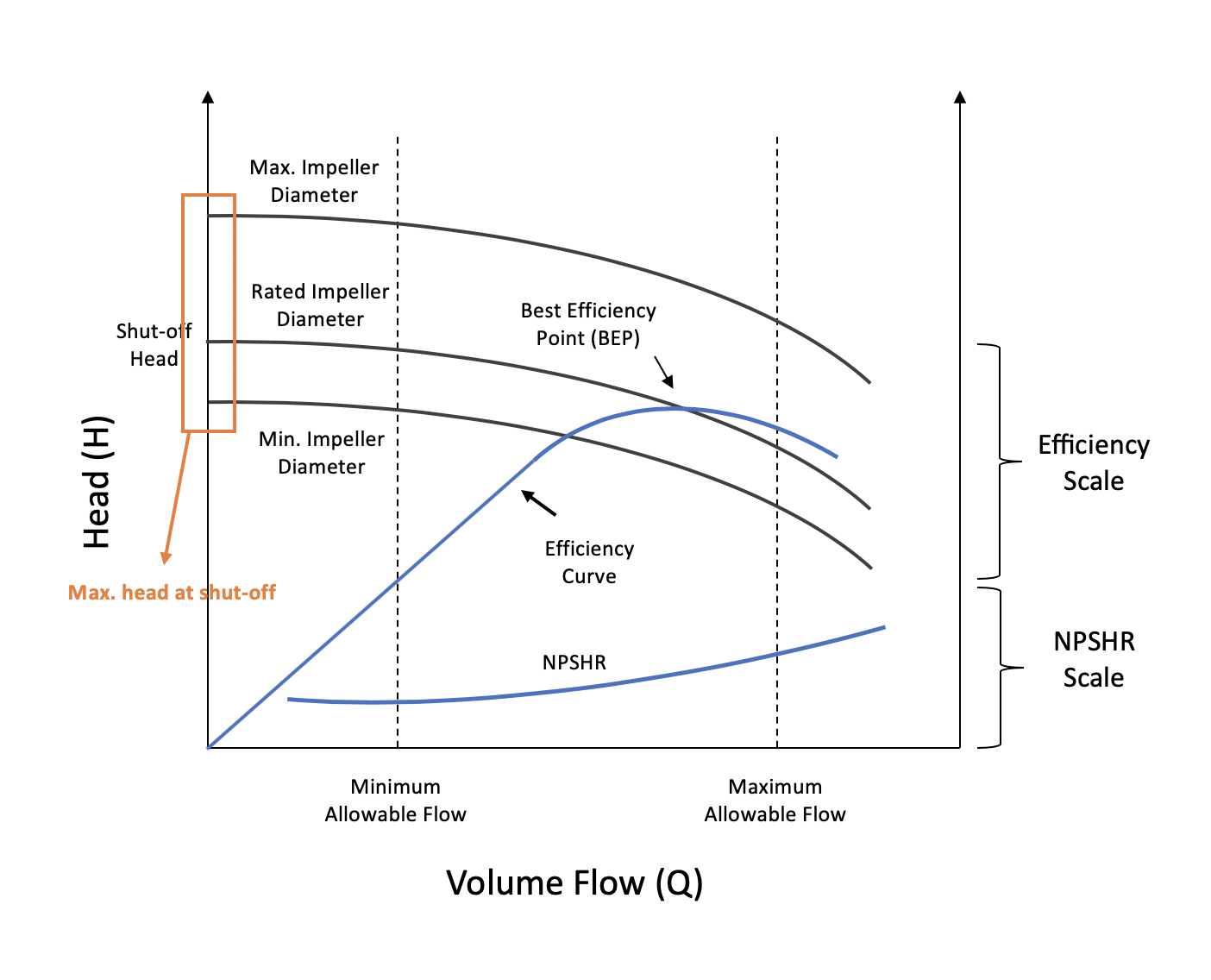
Pump characteristic curve showing H-Q curves for multiple impeller sizes. Each curve represents performance at different impeller diameters. Shut-off head (maximum head at zero flow) is shown at the left of each curve (Image credit: Shivansh231 - Wikimedia Commons, CC BY-SA 4.0)

Key Elements in Pump Curve:
| Element | Description |
|---|---|
| H-Q Curves | Head vs Flow curve for each impeller diameter |
| Shutoff Head | Point where flow = 0 (leftmost point of curve) |
| Runout | Point of minimum head at maximum flow (rightmost) |
| BEP | Point of maximum efficiency |
2. Head-Flow (H-Q) Curve
2.1 Key Points on H-Q Curve
| Point | Definition | Location |
|---|---|---|
| Shutoff Head | Maximum head at zero flow | Left end of curve |
| Rated Point | Design flow and head | Specified duty point |
| BEP | Best Efficiency Point | Peak efficiency |
| Runout | Maximum flow at minimum head | Right end of curve |
2.2 Curve Shape Characteristics
| Curve Type | Head Rise to Shutoff | Stability | Application |
|---|---|---|---|
| Steep Rising | 20-30% | Very stable | Parallel pumps, variable flow |
| Normal Rising | 10-20% | Stable | General service |
| Flat | <10% | Marginal | Constant head required |
| Drooping | Drops before shutoff | Unstable | Avoid for parallel operation |
Minimum Rise for Parallel Operation (API 610):
Rise to Shutoff = (H_shutoff - H_rated) / H_rated × 100%

Required: ≥ 10% rise for pumps operating in parallel
2.3 Reading Head and Flow
Step-by-step Process:
- Locate required flow on X-axis
- Draw vertical line to intersect pump curve
- Read corresponding head on Y-axis
- Verify curve (impeller diameter) being used
Example:
Required: 400 m³/h

From curve readings:
  - 280mm impeller: H = 85 m
  - 260mm impeller: H = 70 m
  - 240mm impeller: H = 55 m

If process requires 75 m head at 400 m³/h:
  → Select between 260mm and 280mm
  → Trim 280mm impeller to ~265mm
3. Best Efficiency Point (BEP)
3.1 BEP Definition
BEP is where:
- Maximum hydraulic efficiency occurs
- Minimum radial thrust on impeller
- Minimum shaft deflection
- Lowest vibration and noise
- Longest bearing and seal life
3.2 Operating Regions (API 610)
| Region | Flow Range | Characteristics | Recommendation |
|---|---|---|---|
| Preferred (POR) | 80-110% of BEP | Optimal operation | Normal continuous operation |
| Allowable (AOR) | 70-120% of BEP | Acceptable with monitoring | Short-term operation |
| Outside AOR | <70% or >120% | Risk of damage | Avoid |
3.3 BEP Proximity Calculation
BEP Ratio = (Rated Flow / BEP Flow) × 100%

Example:
  Rated Flow = 450 m³/h
  BEP Flow (from curve) = 500 m³/h

  BEP Ratio = (450 / 500) × 100% = 90%

  Result: 90% of BEP → Within Preferred Operating Region ✓
3.4 Consequences of Operating Away from BEP
| Condition | Consequences |
|---|---|
| Low Flow (<70% BEP) | Internal recirculation, temperature rise, suction recirculation, increased radial thrust, seal damage |
| High Flow (>120% BEP) | Cavitation risk, increased NPSHr, discharge recirculation, excessive vibration |
4. Efficiency Curve
4.1 Efficiency Curve Shape
Efficiency │
    (%)    │              ●  BEP (82%)
    80     │           ╱    ╲
           │         ╱        ╲
    60     │       ╱            ╲
           │     ╱                ╲
    40     │   ╱                    ╲
           │ ╱                        ╲
    20     │╱                          ╲
           └──────────────────────────────
             0    200    400    600    800
                    Flow (m³/h)
4.2 Typical Efficiency Values
| Pump Type | Typical BEP Efficiency |
|---|---|
| Small pumps (<20 kW) | 50-70% |
| Medium pumps (20-200 kW) | 70-80% |
| Large pumps (>200 kW) | 80-90% |
| API 610 pumps | 75-85% typical |
4.3 Energy Cost of Efficiency Drop
Formula:
Annual Energy Cost = (Flow × Head × SG × 9.81 × Hours) / (3600 × η_pump × η_motor) × Rate

Where:
  Flow = m³/h
  Head = m
  SG = Specific Gravity
  Hours = Operating hours/year
  η = Efficiency (decimal)
Rate = $/kWhExample:
Flow = 500 m³/h, Head = 80 m, SG = 1.0
Hours = 8000 hr/yr, Rate = $0.10/kWh, η_motor = 0.95

At η_pump = 80%: Cost = $116,000/yr
At η_pump = 75%: Cost = $124,000/yr

5% efficiency drop = $8,000/year additional cost
5. Power Curve
5.1 Power Curve Characteristics
Power │
(kW)  │                           ╱ End of curve power
      │                         ╱
  80  │                       ╱
      │                     ╱
  60  │                   ╱
      │                 ╱
  40  │               ╱
      │             ╱
  20  │           ╱
      │  ●──────╱ Shutoff power
      └────────────────────────────
           Flow Rate →
5.2 Power Calculation
Shaft Power (kW) = (Q × H × ρ × g) / (η_pump × 3.6 × 10⁶)

Where:
  Q = Flow (m³/h)
  H = Head (m)
  ρ = Density (kg/m³)
  g = 9.81 m/s²
  η_pump = Pump efficiency (decimal)
5.3 Motor Sizing
Rule: Motor must handle power at end of curve (runout)
Motor Power ≥ (Power at runout) × Service Factor

Service Factor:
  - Standard service: 1.10
  - API 610: 1.15
  - Critical service: 1.25
6. NPSHr Curve
6.1 NPSHr Curve Behavior
NPSHr │
(m)   │                             ╱ Steep rise at high flow
      │                           ╱
  10  │                         ╱
      │                       ╱
   6  │                     ╱
      │                   ╱
   4  │               ╱
      │           ╱
   2  │  ●────╱ Relatively flat at low flow
      └────────────────────────────
           Flow Rate →
6.2 Key NPSHr Insights
| Flow Range | NPSHr Behavior | Critical Check |
|---|---|---|
| Low flow | Relatively stable | Check at minimum continuous flow |
| BEP | Moderate increase | Check at rated point |
| High flow | Steep increase | Critical - check at runout |
6.3 NPSH Margin Verification
NPSH Margin = NPSHa - NPSHr

API 610 Requirement:
  Margin ≥ MAX(1.0 m, 0.3 × NPSHr)

Example at 500 m³/h:
  NPSHa = 8.0 m (calculated)
  NPSHr = 5.0 m (from curve)
  Required margin = MAX(1.0, 0.3 × 5.0) = 1.5 m

  Actual margin = 8.0 - 5.0 = 3.0 m ✓
7. System Curve
7.1 System Curve Components
H_system = H_static + H_friction

Where:
  H_static = (Z₂ - Z₁) + (P₂ - P₁)/(ρg)  [Fixed]
  H_friction = K × Q²  [Varies with flow squared]
7.2 System Curve Plot
Head │
     │                        System Curve
     │                      ╱
     │                    ╱
     │                  ╱
     │                ╱  ← Friction head (varies with Q²)
     │              ╱
     │────────────╱
     │ ↑ Static head (constant)
     │
     └────────────────────────────
          Flow Rate →
7.3 System Curve Calculation Example
Given:
  Static head = 20 m
  Friction at 500 m³/h = 30 m

Calculate K:
  K = H_friction / Q² = 30 / 500² = 0.00012

System curve equation:
  H = 20 + 0.00012 × Q²

At different flows:
  Q = 0:     H = 20 m
  Q = 250:   H = 20 + 7.5 = 27.5 m
  Q = 500:   H = 20 + 30 = 50 m
  Q = 750:   H = 20 + 67.5 = 87.5 m
8. Operating Point Analysis
8.1 Finding Operating Point
The operating point is where pump curve intersects system curve:
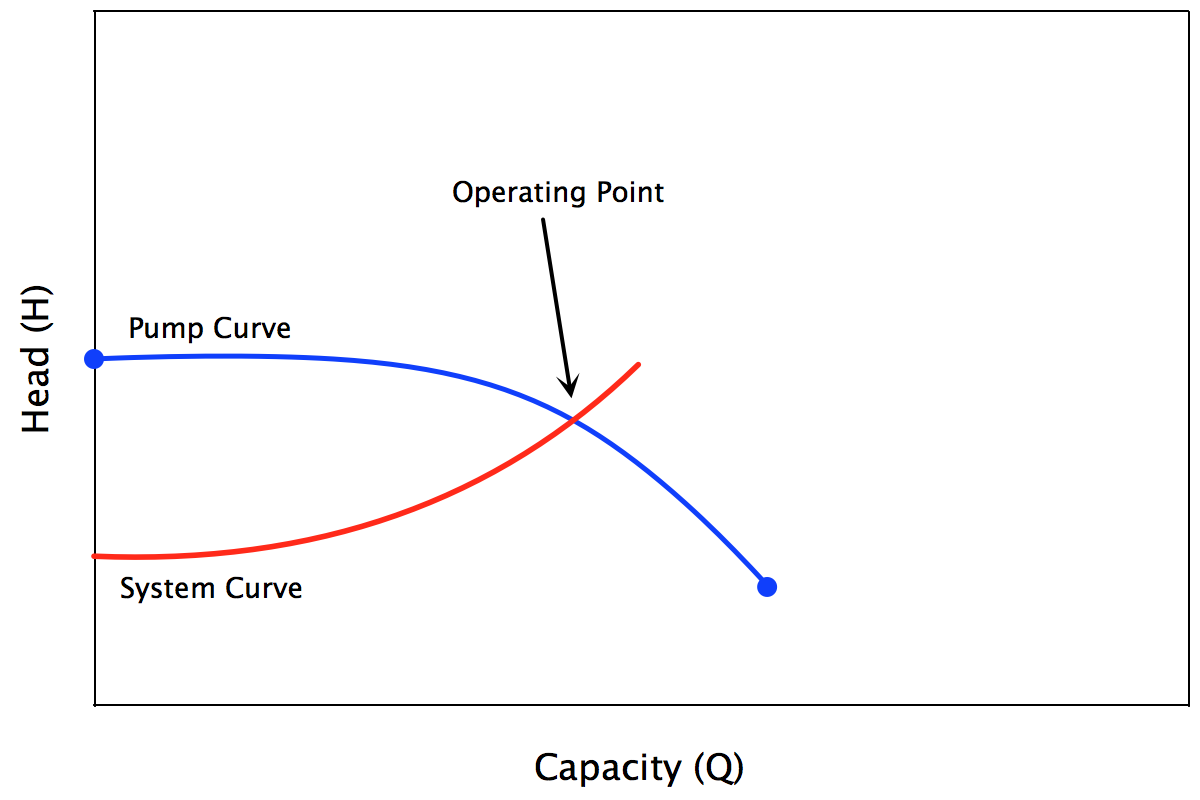
Intersection of Pump Curve and System Curve defines the Operating Point - this shows the actual flow and head at which the pump operates in that specific system (Image credit: Toomey usf - Wikimedia Commons, CC BY-SA 4.0)

8.2 Operating Point Scenarios
| Scenario | Description | Solution |
|---|---|---|
| Pump curve below system | Pump cannot overcome head | Larger pump or reduce friction |
| Operating point far left of BEP | Over-sized pump | Trim impeller or use VFD |
| Operating point far right of BEP | Under-sized pump | Larger pump or reduce demand |
| No intersection | Wrong pump selection | Re-select pump |
9. Affinity Laws
9.1 Speed Change (Constant Diameter)
Q₂/Q₁ = N₂/N₁
H₂/H₁ = (N₂/N₁)²
P₂/P₁ = (N₂/N₁)³
9.2 Diameter Change (Constant Speed)
Q₂/Q₁ = D₂/D₁
H₂/H₁ = (D₂/D₁)²
P₂/P₁ = (D₂/D₁)³
9.3 Worked Examples
Example 1: Speed Reduction
Original: N₁ = 2950 rpm, Q₁ = 500 m³/h, H₁ = 80 m, P₁ = 150 kW
New speed: N₂ = 2500 rpm

Ratio = 2500/2950 = 0.847

Q₂ = 500 × 0.847 = 424 m³/h
H₂ = 80 × 0.847² = 57 m
P₂ = 150 × 0.847³ = 91 kW

Power savings = 150 - 91 = 59 kW (39% reduction!)
Example 2: Impeller Trim
Original: D₁ = 280 mm, Q₁ = 500 m³/h, H₁ = 80 m
Required: H₂ = 70 m at same Q

D₂/D₁ = √(H₂/H₁) = √(70/80) = 0.935
D₂ = 280 × 0.935 = 262 mm

Trim impeller to 262 mm
9.4 Affinity Laws Limitations
| Limitation | Impact |
|---|---|
| Efficiency changes | Laws assume constant efficiency; actual η varies slightly |
| Large changes | Accuracy decreases for >25% change |
| Viscous fluids | Additional correction needed |
| Specific speed | Different pump types respond differently |
10. Parallel and Series Pump Operation
10.1 Parallel Operation
Principle: Add flows at same head
| Parameter | Single Pump | Two Pumps (Parallel) |
|---|---|---|
| Head | H | H (unchanged) |
| Flow | Q | Q₁ + Q₂ ≈ 2Q |
| Curve shift | - | Horizontal (wider) |
Formula:
Combined Head: H_combined = H_single (at any flow)
Combined Flow: Q_combined = Q₁ + Q₂ (at same head)
Example:
- Single pump: 100 m³/h at 50 m head
- Two pumps parallel: 200 m³/h at 50 m head
Requirements for Parallel Operation:
- Rising head curve (no drooping)
- Minimum 10% rise to shutoff
- Similar pump characteristics
- Check valves on each pump discharge
10.2 Series Operation
Principle: Add heads at same flow
| Parameter | Single Pump | Two Pumps (Series) |
|---|---|---|
| Head | H | H₁ + H₂ ≈ 2H |
| Flow | Q | Q (unchanged) |
| Curve shift | - | Vertical (higher) |
Formula:
Combined Flow: Q_combined = Q_single (at any head)
Combined Head: H_combined = H₁ + H₂ (at same flow)
Example:
- Single pump: 100 m³/h at 50 m head
- Two pumps series: 100 m³/h at 100 m head
When to Use Series vs Parallel:
| Requirement | Configuration |
|---|---|
| More flow, same head | Parallel |
| More head, same flow | Series |
| Variable demand | Parallel with staging |
| High head, low flow | Multistage (internal series) |
11. Specific Speed
11.1 Specific Speed Calculation
Ns = N × √Q / H^0.75

Where:
  Ns = Specific speed (dimensionless when using SI units)
  N = Speed (rpm)
  Q = Flow per impeller eye (m³/s)
  H = Head per stage (m)
11.2 Specific Speed and Impeller Type
| Ns Range | Impeller Type | H-Q Curve Shape | Typical Efficiency |
|---|---|---|---|
| 10-30 | Radial | Steep, high rise | 60-80% |
| 30-50 | Francis (radial/mixed) | Moderate rise | 75-88% |
| 50-80 | Mixed flow | Flatter | 80-90% |
| 80-150 | Mixed flow | Flat | 82-92% |
| 150-300 | Axial flow | Very flat/drooping | 80-90% |
12. Troubleshooting Using Pump Curves
12.1 Common Problems and Curve Diagnosis
| Problem | Curve Indication | Root Cause |
|---|---|---|
| Low flow | Operating point shifted left | Higher system resistance than design |
| High flow | Operating point shifted right | Lower system resistance than design |
| Low head | Operating on lower impeller curve | Wrong impeller or wear |
| Cavitation | Operating past NPSHr crossover | Insufficient NPSHa |
| Motor overload | Operating past motor curve | System friction lower than design |
12.2 Troubleshooting Flowchart
Problem: Pump not delivering expected flow
                    │
                    ▼
        ┌──────────────────────┐
        │ Check actual head    │
        │ vs curve at measured │
        │ flow                 │
        └──────────────────────┘
                    │
        ┌───────────┼───────────┐
        ▼           ▼           ▼
    On curve    Below curve   Above curve
        │           │           │
        ▼           ▼           ▼
   System issue  Pump issue   Gauge error
        │           │           │
        ▼           ▼           ▼
   - Valve closed  - Worn impeller  - Verify
   - Strainer      - Wrong rotation   instruments
   - Higher        - Air in pump
     friction      - Wrong impeller
13. Curve Analysis Checklist for Vendor Evaluation
13.1 Required Curve Data
| Item | Check |
|---|---|
| H-Q curve for all impeller diameters | |
| Efficiency curve | |
| Power curve | |
| NPSHr curve | |
| BEP point clearly marked | |
| Rated point marked | |
| Test tolerance band shown |
13.2 Performance Verification
| Parameter | Specification | Offered | Within Tolerance? |
|---|---|---|---|
| Head at rated flow | m | m | ±3% |
| Flow at rated head | m³/h | m³/h | ±3% |
| Efficiency | ≥ % | % | ≥spec or ≤5% below |
| NPSHr | ≤ m | m | ≤ guaranteed |
| BEP ratio | 80-110% | % |
14. Quick Reference Tables
14.1 Affinity Laws Summary
| Parameter | Speed Change | Diameter Change |
|---|---|---|
| Flow (Q) | Q ∝ N | Q ∝ D |
| Head (H) | H ∝ N² | H ∝ D² |
| Power (P) | P ∝ N³ | P ∝ D³ |
14.2 Operating Region Limits
| Region | % of BEP Flow | Vibration | Reliability |
|---|---|---|---|
| Preferred | 80-110% | Low | Excellent |
| Allowable | 70-120% | Acceptable | Good |
| Outside | <70% or >120% | High | Poor |
Image Credits
| Image | Source | License |
|---|---|---|
| Pump Characteristic Curve | Shivansh231 - Wikimedia Commons | CC BY-SA 4.0 |
| Pump Curve and System Curve | Toomey usf - Wikimedia Commons | CC BY-SA 4.0 |